

Get a Free Quote
Tell us what you need and our CleanMitra team will contact you.
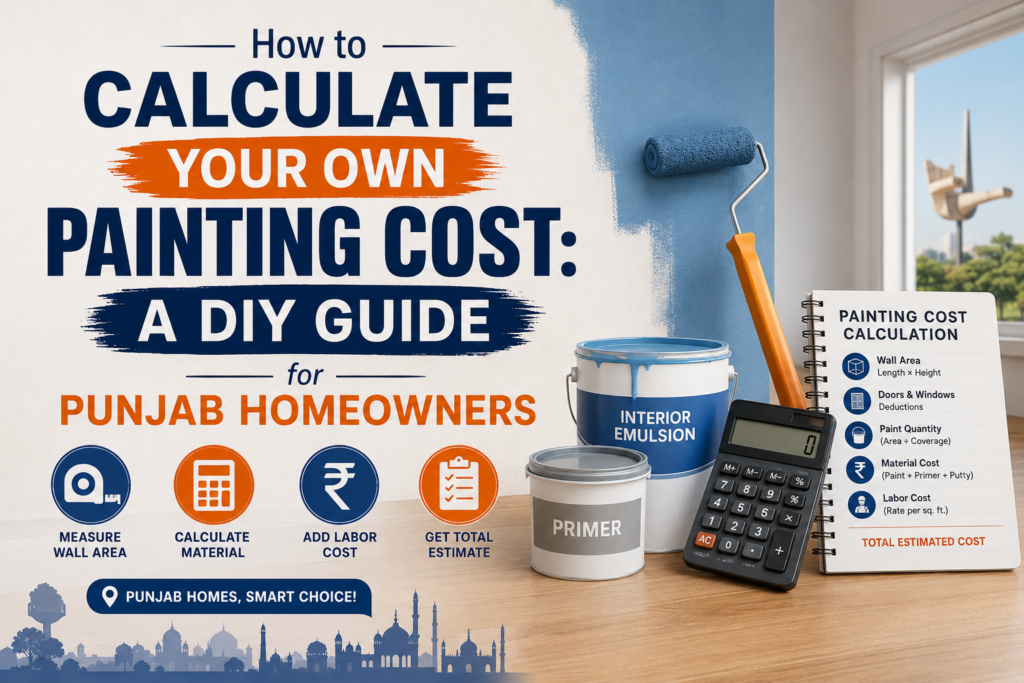
How to Calculate Your Own Painting Cost: A DIY Guide for Punjab Homeowners
You’ve called three contractors for quotes, and somehow you’ve gotten three completely different numbers — for the same house. One quote is double another. None of them explain how they arrived at the figure. If this sounds familiar, you’re not alone, and you’re not imagining the confusion.
Painting quotes in Chandigarh, Mohali, and Ludhiana can feel like a black box. Contractors throw around square footage numbers that don’t match your own sense of your home’s size, add vague line items for “material” and “labour,” and expect you to just trust the total. The good news is that the math behind a painting quote isn’t actually complicated — it’s just rarely explained. Once you understand how paintable area, hidden prep costs, and the labour-to-material ratio work, you’ll be able to look at any quote and immediately tell whether it’s fair or inflated.
This guide walks you through the exact “painter’s math” that professional estimators use, step by step, so you can either calculate a rough estimate yourself or simply hold your contractor accountable to the same logic.
Why does this gap between contractors exist in the first place? Part of it comes down to how painting is sold in this market. Unlike, say, buying tiles or furniture where the price per unit is printed and comparable across shops, a painting quote bundles together area calculation, material grade, number of coats, surface condition, and labour skill into a single number — and every contractor is free to make their own assumptions about each of those variables. Two contractors looking at the exact same house can produce wildly different totals simply because one assumed two coats of putty and premium emulsion, while the other assumed one coat and a standard finish, without ever telling you which assumptions they made. This guide exists to strip away that ambiguity so you’re comparing apples to apples, not just bottom-line numbers.
By the end of this guide, you’ll be able to do three things confidently: estimate your own home’s paintable area within a reasonable margin, recognize which cost categories are commonly hidden or underquoted, and ask the exact questions that force any contractor’s quote into the open. None of this requires special tools or training — just the same formulas that professional estimators use every day, explained plainly.
The Painter’s Math: How to Measure Your Own Walls
Every professional painting quote, no matter how it’s presented, is built on the same underlying calculation: figure out the total paintable surface area, then multiply by a rate per square foot that covers material and labour. Here’s how to do that calculation yourself, room by room.
1 Calculate the Paintable Wall Area
Start by measuring the perimeter of the room (the total length of all four walls added together), then multiply by the wall height. This gives you the gross wall area before any deductions.
Paintable Area = Perimeter of Room × Height of Wall
Worked Example
A bedroom measuring 12 ft. × 10 ft. has a perimeter of (12+10)×2 = 44 ft.
With a standard wall height of 10 ft.: 44 × 10 = 440 sq.ft. of gross wall area
2 Subtract Openings — Windows and Doors
Doors and windows don’t get painted, so they need to be deducted from your gross wall area to arrive at the true paintable surface. Use these standard approximations if you haven’t measured your specific openings:
- Windows: deduct approximately 12 sq.ft. per standard window
- Doors: deduct approximately 21 sq.ft. per standard door
Continuing the Example
Our 440 sq.ft. bedroom has 2 windows and 1 door:
Deduction: (2 × 12) + (1 × 21) = 24 + 21 = 45 sq.ft.
Net paintable wall area: 440 − 45 = 395 sq.ft.
3 Don’t Forget the Ceiling
If your quote includes ceiling painting — which many full-room jobs do — this needs to be calculated separately from wall area, since it’s a different surface with different prep needs.
Ceiling Area = Length × Width
Continuing the Example
Our 12 ft. × 10 ft. bedroom ceiling: 12 × 10 = 120 sq.ft.
Total paintable surface (walls + ceiling): 395 + 120 = 515 sq.ft.
4 The Rule of Thumb — A Faster Shortcut
If you don’t want to measure every wall individually, professional estimators use a simpler rule of thumb based on your home’s carpet area (the floor area inside your walls, excluding common areas).
Rough Paintable Wall Area = Carpet Area × 3.5
Why 3.5?
This multiplier accounts for standard ceiling heights (9-10 ft.), typical wall-to-floor ratios in Indian homes, and average door/window proportions. It won’t be as precise as measuring room by room, but it’s a reliable ballpark for budgeting before you get formal quotes.
Example: a 1,000 sq.ft. carpet area home → 1,000 × 3.5 = ~3,500 sq.ft. of paintable wall area
Putting It All Together: A Full-Home Worked Example
Single-room math is useful for understanding the formula, but most homeowners want to know what this looks like across an entire house. Let’s walk through a typical 3 BHK independent floor common across Mohali and Zirakpur sectors, applying the same steps room by room.
| Room | Dimensions (ft.) | Gross Wall Area | Openings Deducted | Net Paintable Area |
|---|---|---|---|---|
| Master Bedroom | 14 × 12 | 520 sq.ft. | 45 sq.ft. (2 windows, 1 door) | 475 sq.ft. |
| Second Bedroom | 12 × 10 | 440 sq.ft. | 45 sq.ft. (2 windows, 1 door) | 395 sq.ft. |
| Living Room | 16 × 14 | 600 sq.ft. | 57 sq.ft. (3 windows, 1 door) | 543 sq.ft. |
| Kitchen | 10 × 9 | 380 sq.ft. | 33 sq.ft. (1 window, 1 door) | 347 sq.ft. |
| Two Bathrooms | 6 × 5 each | 440 sq.ft. (combined) | 42 sq.ft. (combined) | 398 sq.ft. (combined) |
Adding these together gives a total net paintable wall area of roughly 2,158 sq.ft. for this home’s interior walls alone — before factoring in ceilings or any exterior surfaces. Compare this to the rule-of-thumb shortcut: a home like this typically has a carpet area around 1,000-1,100 sq.ft., which at the 3.5 multiplier would suggest roughly 3,500-3,850 sq.ft. The gap between the two numbers usually reflects ceiling area, corridor and staircase walls, and balcony surfaces that the room-by-room method above didn’t include in this simplified example — which is exactly why the rule of thumb tends to run higher than a strict room-by-room tally of living spaces alone.
The lesson here isn’t that one method is “right” and the other “wrong” — it’s that both are useful for different purposes. Room-by-room measurement gives you precision for getting an exact quote on a specific set of rooms. The carpet-area shortcut gives you a fast sanity check across your whole home before you even start collecting quotes, so you walk into contractor conversations with a number already in mind.
Common Measurement Mistakes to Avoid
- Forgetting overlapping corners — when measuring perimeter, walk the full boundary continuously rather than measuring each wall separately and adding them, which can introduce small double-counting errors at corners.
- Using floor area instead of wall area — these are different numbers by design; a small room with high ceilings can have more paintable wall area than a larger room with low ceilings.
- Assuming all doors and windows are standard size — large picture windows, French doors, or balcony sliding doors deduct significantly more area than the 12 sq.ft./21 sq.ft. averages used above; measure these specifically if your home has them.
- Ignoring textured or uneven walls — rough or textured surfaces don’t change the area calculation, but they do increase paint and putty consumption, which affects the material side of your quote even though the square footage stays the same.
Hidden Factors That Quotes Often Leave Out
The square footage calculation is only half the picture. A surprising number of homeowners get blindsided not by the math itself, but by cost categories that never got mentioned clearly upfront. Here’s what to watch for.
Surface Preparation
Putty application and sanding to smooth walls before painting. This is often quoted separately, or worse, not quoted at all until it’s added as a surprise.
Primer Application
An essential coat that improves adhesion and paint longevity, sometimes left out of “per coat” pricing to make a quote look lower.
Labour-to-Material Ratio
Industry-typical split is around 60% labour to 40% material. If a quote’s labour share looks unusually high, it’s worth asking why.
Why Surface Preparation Gets Underquoted
Putty and sanding are labour-intensive but don’t involve expensive materials, so some contractors minimize this line item to make their overall quote look more competitive on paper. The problem is that skipping or rushing this step is exactly what causes patchy, uneven finishes and early paint failure — the homeowner ends up paying for the consequences later, just not on the original invoice.
Why the Labour-to-Material Ratio Matters
Understanding this ratio gives you a built-in sanity check for any quote. If a contractor’s material cost seems unusually low relative to their labour charge, it could mean lower-grade paint is being used to pad their margin. If labour seems unusually low, it could mean rushed application or an inexperienced crew. Knowing the rough 60:40 split lets you ask informed questions instead of just accepting a bottom-line number.
Other Costs That Sometimes Get Bundled or Skipped
Beyond prep, primer, and the labour-material split, a few additional cost categories are worth watching for, since they don’t always appear as their own line item:
- Scaffolding or ladder rental for multi-storey exteriors or high ceilings, which adds to labour cost but is sometimes folded silently into a flat “exterior” rate.
- Crack and minor plaster repair — small repairs are often assumed to be included, but extensive crack filling on older walls can be a separate cost that only gets mentioned once work has started.
- Furniture covering and floor protection — a professional crew should account for this in their process, but it’s worth confirming it’s included rather than assumed.
- Cleanup and waste disposal — removing paint tins, dust sheets, and debris after the job is finished should be part of the service, not an afterthought billed separately.
- Travel or site-visit charges — some contractors charge a nominal fee just for providing an on-site estimate, which is worth asking about before you schedule a visit.
How This Compares Across the Tricity Region
While the underlying math — paintable area, prep, primer, coats — stays the same everywhere, the rates contractors apply to that area can vary noticeably between Chandigarh, Mohali, and Ludhiana, largely due to differences in labour cost and local competition. Chandigarh’s well-established contractor market often means more standardized pricing and clearer itemization, simply because homeowners there are more likely to compare multiple quotes. Mohali and Zirakpur’s newer construction boom means many contractors are pricing fresh-plaster jobs, which require different prep assumptions than repainting older homes — worth flagging explicitly if your home falls into either category. Ludhiana’s larger industrial and independent-house market sometimes sees wider quote variation precisely because there’s less price transparency between contractors, which makes the question-asking approach in the next section even more valuable there.
Math can be confusing. Do not worry about the manual calculations. Please visit our painting cost calculator for a free, instant estimate tailored to your home.
Painting Cost Calculator – Get a Free EstimateHow to Interrogate Your Contractor’s Quote
Once you understand the math, the smartest thing you can do with a contractor’s quote isn’t to recalculate it from scratch — it’s to ask a few pointed questions that reveal whether their numbers hold up. Here are the three that matter most.
“What is the paintable square footage you are using for this quote?”
This forces the contractor to state their area calculation explicitly. If their number is dramatically different from your own rough estimate using the formulas above, ask them to walk through how they arrived at it.
“Does this include two coats of putty, or just one?”
Single-coat putty is cheaper but often leaves visible imperfections, especially on older or uneven walls. Two coats is the standard for a smooth, long-lasting finish — make sure you know which one you’re paying for.
“Is primer included, and how many coats of finish paint follow it?”
A quote that skips primer or only includes a single finish coat will look cheaper but typically results in patchier coverage and a shorter-lasting paint job. Confirm the full coat sequence before agreeing to a price.
A Quick Reference for Comparing Multiple Quotes
| What to Check | Red Flag | Fair Practice |
|---|---|---|
| Paintable Area Stated | Vague or unexplained number | Clearly broken down by room |
| Putty Coats | Not specified | 2 coats explicitly mentioned |
| Primer | Missing from the quote | Included as a separate line item |
| Finish Coats | Only 1 coat | 2 coats minimum |
| Labour vs. Material Split | Heavily skewed either way | Roughly balanced near 60:40 |
Understanding the painting cost per square foot in this way puts you in a much stronger position during negotiations. You’re no longer comparing total numbers blindly — you’re comparing the actual scope of work behind each number.
💬 Want a transparent, itemized estimate without the guesswork? Get Quote from CleanMitra — no hidden line items, no surprises.
DIY Math vs. Professional Execution
There’s real value in understanding this DIY painting guide approach — it makes you a more informed homeowner and protects you from being overcharged. But it’s worth being honest about where DIY calculation should end and professional judgment should begin. Measuring your own walls and understanding the paintable area formula is excellent preparation. Actually executing the surface prep, primer application, and finish coats to a professional standard is a different skill entirely, and it’s where most of the long-term value of a paint job actually comes from.
A homeowner who understands the math but hires inexperienced labour to save money often ends up with a technically “correct” square footage and a visibly poor finish. The real goal of this guide isn’t to turn you into your own painter — it’s to make sure that when you do hire professionals, you know exactly what you’re paying for and can hold them accountable to it.
Frequently Asked Questions
Is the 3.5 multiplier accurate for every home?
It’s a reasonable average for typical Indian residential layouts with standard ceiling heights, but homes with unusually high ceilings, large open-plan areas, or extensive balcony space will see more variation. Use it for early budgeting, and switch to room-by-room measurement once you’re comparing formal quotes.
Should I measure my own home or just trust the contractor’s number?
Doing a rough measurement yourself first — even using just the rule of thumb — gives you a reference point. You don’t need to be exact; you just need a number close enough to recognize if a contractor’s figure is wildly off.
Why do two contractors quote such different total prices for the same paintable area?
Usually it comes down to paint grade, number of coats, and how much surface prep is included — exactly the factors covered in the hidden costs section above. Same area, different scope of work.
Does this math apply to exterior walls too?
The same perimeter × height formula applies, but exteriors typically need different paint types and more prep work, which changes the material side of the calculation even when the area formula stays identical.
What if my contractor refuses to break down their quote when asked?
Treat that as a meaningful signal. A contractor confident in their pricing should have no issue explaining their area calculation, coat count, and material choice — reluctance to do so is worth factoring into your decision.
Conclusion: Knowledge Is Your Best Negotiating Tool
Understanding the math behind your painting quote — paintable area, hidden prep costs, and the labour-to-material ratio — is the single best way to avoid overpaying and ensure a quality result. While DIY calculation is a great starting point for budgeting and comparing quotes, professional execution is what ultimately determines whether your paint job lasts years or fails within months. CleanMitra’s painting services in Punjab are built around exactly this kind of transparency, so you always know what you’re paying for and why.
Ready to start? Please visit our painting cost calculator for a free estimate, or reach out to us on WhatsApp to speak with our experts.