
Get a Free Quote
Tell us what you need and our CleanMitra team will contact you.
How to Fix
Damp Walls
Permanently.
A complete guide for Chandigarh homeowners — understand what is actually causing your damp walls, which fixes work permanently, and what never to skip before repainting.
Damp walls are one of the most common and most misunderstood problems in Chandigarh homes. Every monsoon brings fresh patches, every winter reveals new stains — and most homeowners keep painting over the problem without ever fixing it. This guide changes that.
Why Damp Walls Are More Than Just Ugly
Most homeowners treat damp walls as a cosmetic issue — repaint and move on. That is the single biggest mistake. Damp walls are a structural and health problem that gets worse every season you ignore it. Here is what is actually happening inside your walls:
- 01 Moisture trapped inside walls weakens the plaster layer from the inside — leading to bulging, cracking, and eventually complete plaster failure
- 02 Persistent damp creates the perfect conditions for mould and fungal growth — a serious respiratory health risk, especially for children and elderly residents
- 03 Water seeping into walls reaches the internal RCC structure, causing steel reinforcement rods to rust and expand — which cracks concrete from the inside
- 04 Paint applied over damp walls never bonds properly — it peels within weeks regardless of how premium the brand is
- 05 Electrical fittings inside damp walls become a serious safety hazard — short circuits and shocks become a real risk
- 06 Ignored seepage in bathrooms and terraces reaches neighbouring flats — leading to disputes, repair liability, and significant expense
The good news is that every one of these problems has a permanent solution — if addressed correctly and in the right order. CleanMitra has fixed damp wall issues across hundreds of homes in Chandigarh, Mohali, and Panchkula. This is exactly what we have learned.
What Is Actually Causing Your Damp Walls
Before you fix anything, you need to correctly identify the source. Damp walls in Chandigarh homes typically come from one of six root causes — and each requires a different treatment approach:
Monsoon Seepage
Rain water penetrating exterior walls through cracks in plaster, joints, and window frames. Extremely common in Chandigarh’s older sectors and any building over ten years old without weatherproof coating.
Terrace Leakage
Cracks or failure in the terrace waterproofing layer allowing water to pool and seep down through roof slabs into the top floor ceiling and walls. One of the most damaging sources of moisture.
Bathroom & Kitchen Seepage
Failed waterproofing in wet areas — particularly around floor drains, bath edges, and wall-floor junctions — allows water to penetrate floor slabs and adjacent walls over time.
Rising Damp
Groundwater travelling upward through the base of walls via capillary action. Common in older buildings without a proper damp-proof course at the foundation level. Walls are wet near the floor year-round.
Plumbing Leaks
Hidden pipe leaks inside walls — supply lines, drainage pipes — creating wet patches that appear unrelated to rain. Often misidentified as seepage until the leak is discovered by pressure testing.
Condensation
In Chandigarh winters, warm interior air meets cold exterior walls and releases moisture. Walls in north-facing rooms and poorly ventilated corners show persistent damp patches even with no rain or leakage.
→ How to Identify Your Damp Type Before Spending Anything
- Damp only after rain or monsoon → likely exterior wall seepage or terrace leak
- Damp near floor year-round, white salt deposits on wall → rising damp from foundation
- Damp patches in specific spots not linked to weather → check for plumbing leak first
- Damp in winter on cold north-facing walls with no rain → condensation issue
- Damp spreading downward from ceiling → terrace waterproofing failure above
- Damp around bathroom or kitchen wall → wet area waterproofing has failed
Painting over a damp wall is not a solution. It is an expensive delay. The moisture is still there — it is just hiding under fresh paint until next monsoon.
— The CleanMitra Team, ChandigarhFixes That Fail — And Why People Keep Trying Them
Most homeowners in Chandigarh have tried at least one of these approaches before calling us. They feel like solutions — they look like solutions — but they are temporary at best and make the underlying problem worse at worst.
✗ Fixes That Do Not Work Permanently
- Applying waterproof paint directly over damp or wet walls — the paint cannot bond to a wet substrate and will peel within one season
- Replastering without treating the moisture source — the new plaster absorbs the same damp and fails just as fast
- Applying putty or skim coat over stained walls without addressing the leak — the stains bleed through within weeks
- Using Dr. Fixit or similar products as a surface application only without cleaning out cracks and filling properly — water finds new paths
- Painting with two coats of premium exterior paint without applying the correct weatherproof primer first
- Fixing only the visible damp patch without tracing back to the actual source — the problem always returns
How to Fix Damp Walls Permanently — The Right Process
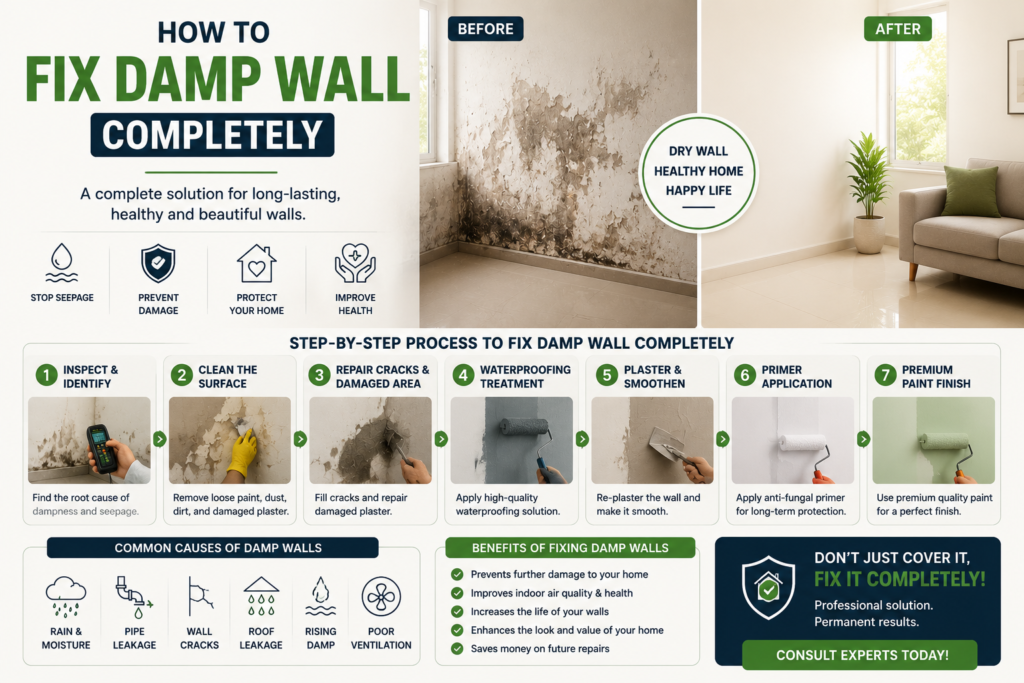
There is no shortcut to a permanent fix. Every step below matters — skip any one of them and the problem will return. This is the exact process CleanMitra follows on every waterproofing and repair project in Chandigarh:
Identify and Eliminate the Water Source
Before any repair work begins, the entry point of water must be found and blocked. This means inspecting terrace drains, bathroom floors, plumbing lines, exterior wall cracks, and window joints. Treating symptoms without fixing the source is the definition of a temporary repair.
Hack Off Damaged Plaster Completely
All loose, bubbled, or salt-stained plaster must be fully removed back to the bare brick or concrete substrate. Attempting to plaster or paint over damaged plaster creates a weak bond layer that fails quickly. This step is non-negotiable for a lasting result.
Treat the Substrate with Waterproofing Chemical
Once bare brick or concrete is exposed, apply a chemical waterproofing treatment — typically a cementitious or polymer-based compound — directly onto the substrate. This creates a barrier that blocks capillary moisture movement through the wall material itself.
Apply Anti-Fungal Treatment
Any wall that has been damp for a significant period will have mould and fungal spores embedded in the surface. These must be killed with an anti-fungal solution before replastering — otherwise the mould grows back through the new plaster within months.
Replaster with Waterproof Cement Mix
New plaster is applied using a cement mix with an integrated waterproofing additive. This makes the plaster layer itself moisture-resistant rather than relying entirely on surface coatings. Allow full curing time — typically 21 to 28 days — before any painting begins.
Apply Alkali-Resistant Primer
Fresh plaster is alkaline and will destroy standard paint from beneath. An alkali-resistant primer must be applied to neutralise the surface and provide a stable base for the topcoat. Skipping this step causes paint to yellow, blister, and fail rapidly.
Apply Exterior-Grade or Anti-Damp Topcoat
For exterior walls, use a breathable, weather-resistant paint like Berger WeatherCoat or Asian Paints Apex Ultima — these allow trapped moisture vapour to escape while preventing liquid water entry. For interior walls previously affected by damp, use a specialist anti-damp interior paint as the finish coat.
Special Case: Fixing Terrace Leakage in Chandigarh
Terrace leakage is the single most destructive source of water damage in Chandigarh homes — and the most expensive to ignore. Chandigarh’s monsoon dumps intense rainfall that pools on terrace surfaces and finds every crack in the waterproofing membrane. Here is the correct approach:
Remove Old Flooring and Waterproofing
Old tiles or brick bat coba must be removed to expose the RCC slab. Applying new waterproofing over old failed layers never works — water finds its way through the old layer regardless.
Inspect and Repair the RCC Slab
Check the bare slab for cracks, honeycombing, or exposed steel. All cracks must be filled with non-shrink grout or polyurethane sealant before any waterproofing membrane is applied.
Apply Polymer-Modified Waterproofing
A two-component polymer waterproofing membrane — applied in minimum two coats — creates a seamless, flexible barrier across the entire slab surface, including all joints, drains, and parapet junctions.
Ensure Proper Drainage Slope
Water that pools on the terrace will always find a way in eventually. A proper slope of at least 1 in 80 toward drainage points must be created using a levelling screed over the waterproofing layer.
Protection Layer Over Membrane
The waterproofing membrane must be protected from UV degradation and foot traffic. A screed layer, tiles, or purpose-made protection board goes on top before any use.
Treat Parapet Walls Separately
Water does not just enter through the flat surface — it enters through cracks in parapet walls and the junction between parapet and slab. These joints need a flexible sealant treatment as part of any complete terrace waterproofing job.
Waterproofing Products We Trust in Chandigarh
The waterproofing products market in India is flooded with cheap alternatives that fail quickly. Here are the products and types we have found consistently reliable across Chandigarh’s climate conditions:
| Product Type | Best Application | Performance |
|---|---|---|
| Dr. Fixit Pidilite (Polymer Coat) | Terrace, exterior walls | Excellent — industry standard |
| Berger WeatherCoat All Guard | Exterior wall painting | Very Good — breathable, durable |
| Asian Paints Apex Ultima | Exterior wall painting | Very Good — UV and rain resistant |
| Cementitious Waterproofing Mix | Bathrooms, wet area floors | Excellent for below-grade application |
| Epoxy Injection Grouting | Structural cracks in RCC | Permanent fix for active cracks |
| Standard waterproof paint only | Any damp wall surface directly | Fails — not a standalone solution |
Why Chandigarh Homes Are Especially Vulnerable
Chandigarh’s construction landscape creates specific waterproofing challenges that generic advice does not account for. Understanding these will help you make better decisions about your own home:
Older Sector Homes — Built Without Modern Waterproofing Standards
Homes in Sectors 1 through 35 were built in an era when chemical waterproofing was minimal or absent. These homes rely almost entirely on the quality of the original construction — which, after 40 to 60 years, has degraded significantly. Every crack in a joint, every porous brick face, and every failed pointing becomes a water entry point.
Builder Flats in Mohali and Zirakpur — Rushed Construction
The rapid construction pace of Mohali phases 8 through 11, Zirakpur, and Aerocity developments means waterproofing in bathrooms and terraces is often applied quickly and without the curing time required. The result is that many homes show seepage within two to three years of possession — well within the life expectancy of properly applied waterproofing.
Panchkula Hillside Properties — Ground Moisture Issues
Panchkula’s slightly elevated terrain and soil composition creates higher groundwater pressure in some areas. Basement and ground floor walls in certain sectors show persistent rising damp that requires a different treatment approach than rain-driven seepage higher up the building.
Monsoon Intensity Has Increased
Chandigarh’s monsoon has intensified over the past decade — both in total rainfall and in short-duration extreme events. Older waterproofing systems designed for moderate rainfall are now overwhelmed by sudden heavy downpours. Annual inspection and maintenance of terrace and exterior coatings has become essential rather than optional.
What You Can DIY and What You Should Not Touch
Some damp wall issues are manageable without professional help. Others are false economies — every DIY attempt that fails costs you in wasted materials and delays in getting the real fix done. Here is an honest breakdown:
Minor Surface Condensation
Improving ventilation, adding an exhaust fan, or using a dehumidifier can effectively resolve condensation-related dampness in bathrooms and closed rooms without any structural work needed.
Small Hairline Cracks on Exterior
Surface hairline cracks on exterior walls can sometimes be sealed with a quality flexible filler and weatherproof paint — but only after correctly assessing whether the crack is structural or purely cosmetic.
Terrace Leaks, Rising Damp, Structural Cracks, Bathroom Seepage
Any of these require substrate access, chemical treatment, and correct product application sequences. An incorrect DIY attempt typically makes these problems more expensive to fix later — and voids any possibility of a warranty on the repair.
Where CleanMitra Handles Waterproofing in Chandigarh
CleanMitra provides waterproofing assessment, treatment, and painting services across Chandigarh and the entire Tricity area.
Frequently Asked Questions
How long does waterproofing treatment last in Chandigarh?
A properly done waterproofing job — including substrate treatment, correct product application, and appropriate topcoat — should last seven to ten years in Chandigarh’s climate. Terrace waterproofing typically needs inspection and maintenance every five to seven years due to thermal expansion and monsoon stress. Surface-only treatments last one to two seasons at best.
Can I paint over a damp wall directly with waterproof paint?
No — this is one of the most common and costly mistakes homeowners make. Waterproof paint is a barrier coating, not a cure. Applied to a wet or damp substrate, it cannot bond properly and will blister and peel within one monsoon season. The moisture source must be fixed and the wall must be completely dry before any coating is applied.
How do I know if my terrace is the source of my ceiling damp?
The simplest test is a flood test — block the terrace drain temporarily, fill the terrace with a few inches of water, and wait 24 to 48 hours. If the ceiling damp worsens or new stains appear, the terrace is the source. A professional can also do a thermal imaging scan to map moisture paths without destructive investigation.
My builder says the damp is my responsibility after 2 years. Is that correct?
Under Indian construction law, builders are typically liable for structural defects — including waterproofing failures in terraces and external walls — for five years from possession. Bathroom and wet area waterproofing is typically covered for one year. If your building is within this period, pursue the builder formally before spending on repairs yourself.
How long must a wall dry before painting after waterproofing?
This depends on the treatment applied and the ambient conditions. Fresh plaster must cure for a minimum of 21 to 28 days. Chemical waterproofing compounds need 72 hours to seven days before overcoating, depending on the product. In Chandigarh’s monsoon months, drying times extend considerably — moisture meters should be used to confirm the wall is below twelve percent moisture content before any paint is applied.
Is rising damp different from regular seepage and does it need different treatment?
Yes — significantly different. Rising damp travels upward through walls from the foundation via capillary action and appears as persistent wet patches near the floor with white salt deposits (efflorescence). Unlike rain-driven seepage, it is present year-round regardless of rainfall. Treatment involves injecting a damp-proof course chemical into the wall base, a process that requires specialist equipment and cannot be replicated by surface applications.
Can CleanMitra handle both the waterproofing and the painting in one project?
Yes — this is actually the recommended approach. Having one team responsible for both waterproofing and the final paint finish ensures proper sequencing, correct primer selection for the treated surface, and a single point of accountability for the complete result. We handle assessment, waterproofing, replastering, priming, and final painting as a complete scope of work.
Damp Walls Don’t
Fix Themselves.
Let’s End This.
Every season you paint over a damp wall, the problem gets worse and the eventual repair gets more expensive. Moisture is patient — it keeps working on your plaster, your structure, and your health long after the fresh paint looks fine.
CleanMitra has fixed damp wall problems in some of Chandigarh’s oldest homes and some of its newest apartments. The approach is always the same: find the real source, treat it properly, and then paint — in that exact order.
Get in touch for a free site assessment. We will tell you exactly what is causing your damp walls and exactly what it will take to fix them permanently.