

Get a Free Quote
Tell us what you need and our CleanMitra team will contact you.
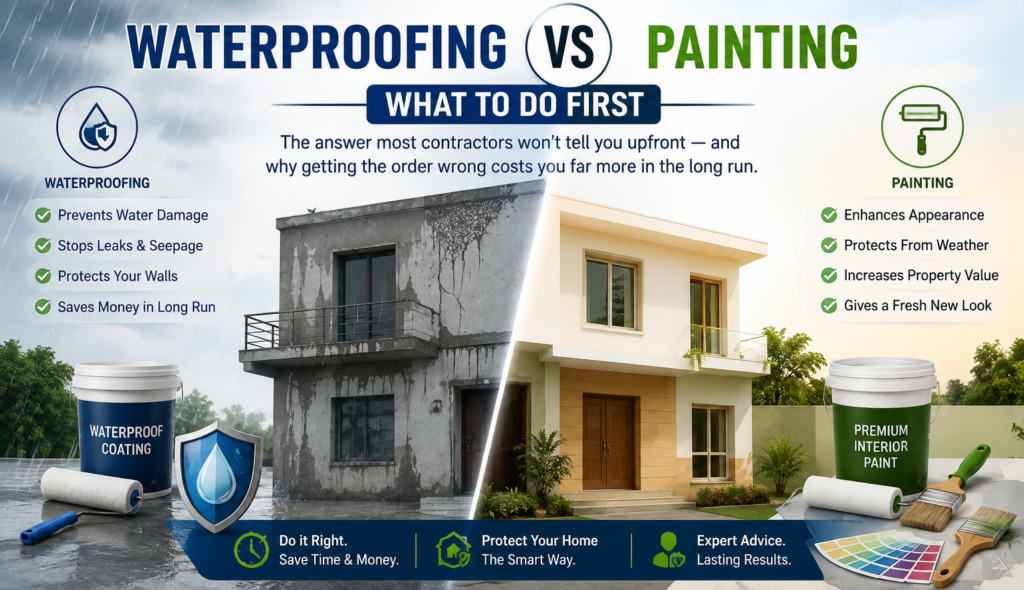
Waterproofing vs Painting: What to Do First
The answer most contractors won’t tell you upfront — and why getting the order wrong costs you far more in the long run.
Walk through any residential neighbourhood in Chandigarh, Mohali, or Ludhiana after the monsoon, and you will spot the same pattern: freshly painted walls with paint already bubbling off, damp patches showing through premium emulsion, and homeowners who spent good money on painting last season having to do it all over again. The culprit, almost every single time, is simple — they painted before waterproofing, or skipped waterproofing entirely.
The question of whether to waterproof or paint first is one of the most commonly misunderstood aspects of home maintenance in Punjab. This guide gives you a clear, practical answer — along with everything you need to know about signs, timing, and how to choose the right treatment for your specific wall situation.
Always waterproof before painting. Painting first and then trying to fix seepage is like putting varnish over wet wood — it fails quickly and costs you far more to redo. In Punjab’s climate, with intense monsoons and extreme summers, waterproofing is not optional for external walls. It is the first step.
Why the Order Matters More Than You Think
Most homeowners assume paint itself provides protection against water. It does — but only on walls that are already dry, stable, and free of seepage. Once water finds its way into a wall through cracks or porous plaster, no amount of premium paint will hold it back. Paint is a surface coating, not a waterproofing membrane.
When you paint over a damp wall, you trap moisture behind a non-breathable layer. In Punjab’s summers — regularly above 44°C in cities like Ludhiana and Amritsar — that trapped moisture expands and creates pressure that causes paint to blister, crack, and peel, sometimes within a single monsoon season.
Punjab Climate Warning
Punjab experiences sub-zero winters in Amritsar, 45°C+ summers in Ludhiana, and heavy monsoon rainfall from July to September. This extreme thermal cycling makes proper waterproofing before painting critical — far more so than in milder regions of India.
The Real Cost of Getting the Order Wrong
Consider a realistic scenario: a homeowner invests in painting their external walls in May. By October, after the first proper monsoon, the paint is peeling in multiple areas. They now need to strip the damaged paint, treat the seepage, re-prime, and repaint. The total remedial cost is often two to three times what a correctly sequenced waterproof-then-paint job would have cost in the first place.
When Exactly Do You Need Waterproofing?
Not every wall needs treatment before painting. Interior walls in a dry room with no seepage history can generally be primed and painted directly. But for exterior walls, terraces, basements, bathrooms, and any wall showing signs of moisture, waterproofing is the non-negotiable first step.
Signs Your Wall Needs Waterproofing Before Painting
Damp Patches
Wet-looking or discoloured patches that appear or worsen after rain — especially on exterior-facing walls or near parapets.
Efflorescence
White, chalky crystalline deposits on wall surfaces — salts carried out by water movement. A reliable indicator of active moisture penetration.
Peeling Previous Paint
If your last coat of paint is peeling or blistering without physical damage, moisture is almost certainly the cause.
Mould or Algae
Black mould patches or green algae streaks — particularly common on north-facing and shaded walls in Chandigarh and Panchkula.
Musty Smell
A persistent damp or musty odour near an interior wall, even without visible moisture, suggests water ingress behind the plaster.
Hairline Cracks
Fine cracks in external plaster — especially near corners or window frames — allow rainwater to enter and migrate behind the plaster.
The Correct Sequence: Step by Step
Whether you are repainting an exterior wall in Patiala or renovating a terrace in Jalandhar, this is the professionally accepted sequence for wall treatment in Punjab:
Surface Inspection and Diagnosis
Identify the source and extent of moisture. Check for active leaks, rising damp, roof seepage, and crack pathways before choosing any treatment. Treating symptoms without identifying the source leads to repeated failure.
Remove Old Damaged Paint and Plaster
Any flaking, bubbling, or mould-affected paint must be removed down to a stable substrate. Applying new treatment over compromised surfaces causes it to fail prematurely.
Repair Cracks and Structural Defects
Fill hairline cracks with flexible crack filler. Wider structural cracks may need epoxy injection or cement-based repair mortar. Window and door frame edges are common ingress points — reseal with weatherproof sealant.
Allow the Wall to Dry Completely
A damp wall cannot be treated effectively. Depending on moisture severity, drying can take from 3 days to 3 weeks. In Punjab’s monsoon season, waiting until October is often the right call for exterior work.
Apply Waterproofing Treatment
Choose the appropriate waterproofing system for your wall type and seepage severity. Apply as per manufacturer specification — number of coats and curing time matter significantly.
Allow Waterproofing to Cure
Most coatings require 24–72 hours of curing before painting. Crystalline products can require up to 7 days. Do not rush this step — curing ensures the membrane fully bonds and hardens.
Apply Primer
A compatible primer ensures adhesion between the waterproofed surface and the finish coat. For exterior walls in Punjab, use a weatherproof or alkali-resistant primer.
Apply Wall Putty if Needed
Putty smooths the primed surface for a uniform finish. For exterior walls, use exterior-grade putty only — interior putty is not designed for moisture or thermal movement exposure.
Apply Finish Paint — Minimum Two Coats
Use a weatherproof exterior emulsion suited to Punjab’s climate. Apply two coats with adequate drying time between each coat.
Types of Waterproofing Used in Punjab Homes
Choosing the right waterproofing system depends on the severity of your problem, the surface type, and the specific wall condition. Here is a practical comparison of the most common treatments used in residential properties across Punjab.
| Treatment Type | Best For | Durability | Severity Level |
|---|---|---|---|
| Cementitious Coating | Rooftops, terraces, water tanks | 5–8 years | Mild–Moderate |
| Acrylic Polymer Coating | External walls, facades | 6–8 years | Mild–Moderate |
| Elastomeric / Flexible Membrane | Cracked facades, expansion joints | 8–12 years | Moderate–Severe |
| Crystalline Waterproofing | Basements, underground walls | 10–15+ years | Severe / Structural |
| Liquid Applied Membrane | Flat roofs, podiums, wet areas | 8–10 years | Moderate–Severe |
| Injection Grouting | Active water leaks, structural cracks | 10+ years | Severe / Active Leak |
Expert Tip: Don’t Guess the Treatment
A common mistake is mixing a waterproofing additive into paint and hoping that suffices. For superficial splash protection on a sound wall it may help marginally, but it is not a treatment for active seepage, rising damp, or structural cracks. Have a qualified contractor assess your specific wall before selecting any product.
Interior Walls vs Exterior Walls: Different Rules
- Exposed to direct rain, sun, and dust storms
- Vulnerable to monsoon-driven water ingress
- Thermal expansion causes microcracks regularly
- Premium paint alone will not stop seepage
- Remedial work far more expensive than prevention
- Dry bedrooms and halls can often be painted directly
- Bathrooms and kitchens always need moisture treatment
- Interior walls adjacent to a seepage-affected exterior wall need treatment
- Basement walls need full waterproofing before any finish
- Never paint over visible interior damp without diagnosis
Punjab-Specific Considerations
Monsoon Timing
Punjab’s monsoon runs from late June to mid-September, with the heaviest rainfall in July and August. Exterior waterproofing and painting should ideally be completed before June or after the monsoon clears in October, when humidity is lower and surfaces dry faster. Chandigarh and Panchkula homeowners often book waterproofing in March–April specifically for this reason.
Flat Rooftop Terraces
Punjab’s independent houses and builder floors almost universally have exposed concrete terraces. These are the most common source of seepage into top-floor ceilings. A proper terrace waterproofing treatment followed by a UV-reflective coating is essential maintenance every 5–7 years — regardless of whether you plan to paint the terrace itself.
Parapet Walls
The joint between a parapet wall and the roof slab is one of the most common failure points for water ingress in Punjab buildings. This area must be specifically sealed with a flexible waterproofing detail before any painting is undertaken on the facade below it.
Salt-Affected Walls in Older Properties
Older properties in Ludhiana, Amritsar, Jalandhar, and Patiala often have severe efflorescence from years of moisture cycling. Simply painting over these walls causes new paint to fail almost immediately. The salt deposits must be removed, the wall treated with a salt-neutralising primer, and then waterproofed before any decorative paint is applied.
City-by-City Note
Mohali’s newer construction often has fewer legacy seepage problems than older city centres like Amritsar’s walled city or Jalandhar’s civil lines. However, construction quality variation in Mohali’s rapid-development sectors means seepage issues are increasingly common even in buildings that are only 5–10 years old. Always inspect before assuming a newer building is problem-free.
Waterproofing First vs Painting First: A Practical Comparison
| Scenario | Short-Term | Long-Term Risk | Overall Value | Verdict |
|---|---|---|---|---|
| Paint only (skip waterproofing) | Lower upfront effort | High — likely to repaint within 2–3 years after monsoon damage | Most expensive over time | Not Recommended |
| Waterproof + Paint (correct sequence) | More effort upfront, done once | Low — no remedial work needed for 6–8 years | Best overall value | Recommended |
| Premium waterproof + Premium paint | Highest upfront investment | Minimal — 8–10 year protection cycle | Best for villas and long-term owners | Best Long-Term |
Common Mistakes Punjab Homeowners Make
- Painting during or immediately after monsoon: High ambient humidity prevents proper paint adhesion. Exterior painting done in August is one of the most common causes of early paint failure in Punjab.
- Using interior putty on exterior walls: Interior putty is not designed for moisture exposure or thermal movement. It absorbs water and breaks down, causing the paint above it to crack and peel.
- Skipping the primer: Going directly from waterproofing to finish paint without a compatible primer significantly reduces adhesion and can cause delamination.
- Choosing the cheapest contractor: Waterproofing is one area where cutting costs at the contractor stage almost always results in a product being skipped, a coat being reduced, or curing time being rushed.
- Not identifying the source of water ingress: Treating a symptom — a damp patch on an interior wall — without identifying the actual source means the treatment fails repeatedly.
- Assuming a new building needs no waterproofing: New construction in Punjab frequently uses fast-set cement and compressed timelines. Settlement cracks appear within 1–3 years and without initial sealing, allow moisture in early.
How CleanMitra Approaches Waterproofing + Painting
Professional home services across Punjab — Chandigarh, Mohali, Panchkula, Ludhiana, Jalandhar, Amritsar & more
CleanMitra follows the correct sequence described in this guide on every project. The initial site visit includes a wall condition evaluation to determine whether waterproofing is needed and which treatment suits the specific moisture problem — before any quote is issued.
Is Your Wall Ready to Paint — or Does It Need Waterproofing First?
Let CleanMitra’s team assess your wall condition and give you an honest, itemised recommendation. Free site visit across Punjab’s major cities.
Frequently Asked Questions
Summary: The Right Way to Protect Your Punjab Home
The answer is unambiguous: waterproof first, always. For Punjab homeowners dealing with intense monsoons, extreme summer heat, and ageing building stock, this is the difference between a wall treatment that lasts a decade and one that starts failing before the next monsoon season. The correct sequence — inspect, dry, repair, waterproof, cure, prime, putty, paint — costs more upfront, but delivers a result that holds for years and costs far less over time than repeating poor work.